Right now
What should you do in the first ten minutes after a pipe bursts?
Knowing what to do when a pipe bursts mostly comes down to order. Each step makes the next one safer.
A split half-inch line can push several gallons a minute through a ceiling. The single most useful thing you can do is stop the supply, because every other step is only cleanup until the water stops.
Close the main shut-off
Turn the house valve clockwise until it stops, or use the customer-side valve in the meter box. A quarter-turn ball valve is closed when the handle sits across the pipe.
Turn off the water heater
Set a gas heater to "pilot" or "off" and switch off the breaker for an electric one. An electric tank that drains while powered can burn out its elements.
Drain the lines
Open the lowest faucet in the house, often a tub spout or a hose bib, plus one upstairs sink. That empties the water still trapped in the pipes so the leak slows to a drip.
Make the electrics safe
If water is reaching outlets, a light fixture or the panel area, shut those breakers off. Never stand in water to reach a panel; call the electric utility instead.
Move and protect belongings
Lift rugs, electronics and paperwork off the floor. Put a bucket under the drip and poke a small drain hole in a bulging ceiling so it does not collapse.
Photograph, then call
Take wide shots and close-ups of the pipe, the ceiling and the floor before you mop. Then call a plumber and describe where the split is and what material it looks like.
Know your valves
Where is the main shut-off on a Central Texas house?
Most homes here are slab-on-grade, so there is no basement valve. Look in two places.
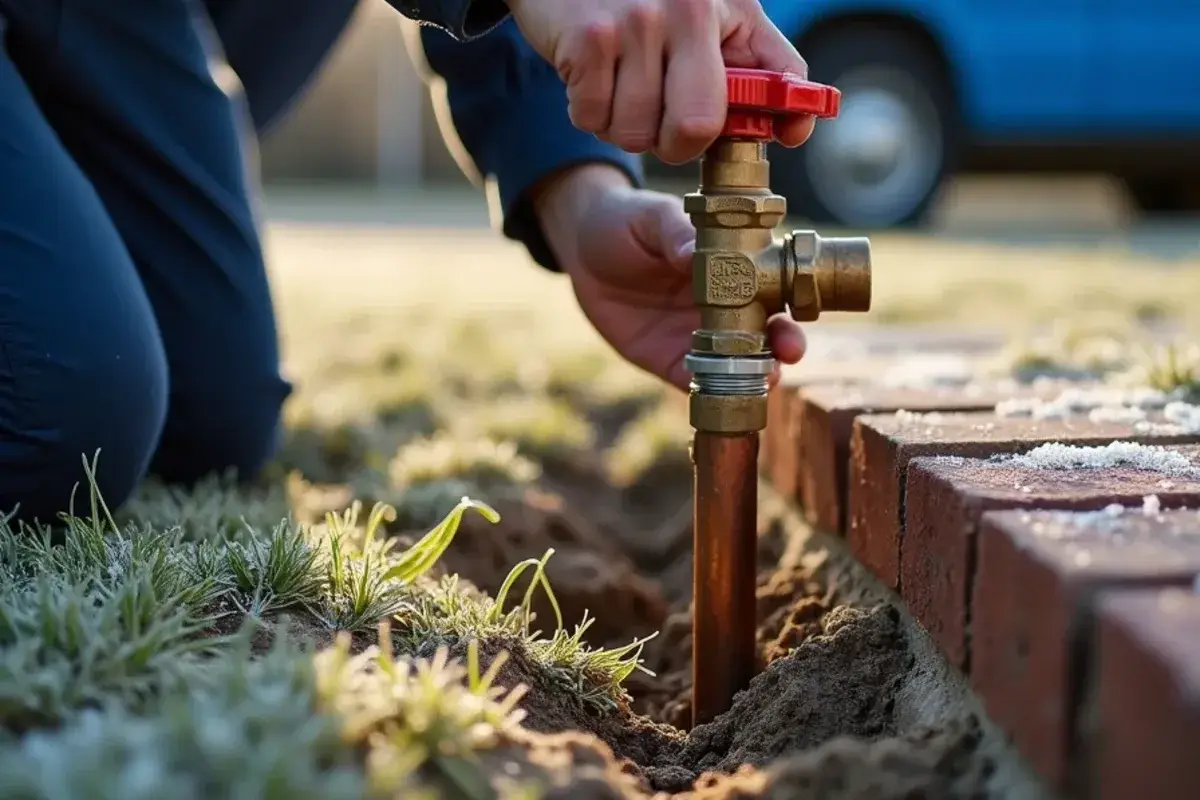
The first is the house valve. It usually sits on the front or side wall near a hose bib, or inside the garage where the line rises out of the slab. On many 1990s and later homes it sits in a small box beside the foundation. Older homes sometimes have only a gate valve that seizes with mineral scale.
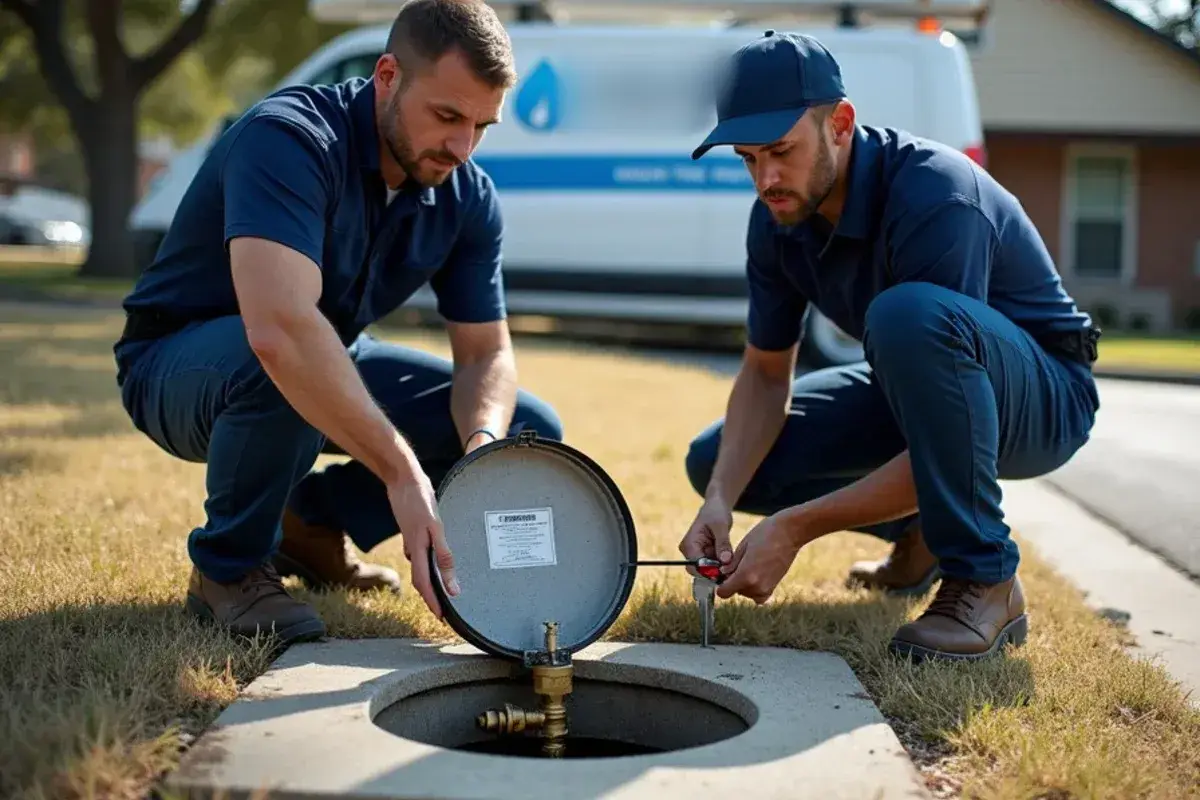
The second is the meter box near the curb. Inside you will see the utility’s valve on the street side of the meter and, in many boxes, a customer-side valve after it. Use the customer-side valve when there is one, and keep a meter key in the garage to lift the lid.
In Round Rock, many of the 1970s and 1980s neighbourhoods west of I-35 were plumbed during the polybutylene years, roughly 1978 to 1995. Those homes often have a grey plastic supply line at the meter and crimp fittings in the attic, where a hard freeze finds them first.
Across Williamson County, the ground changes the job too. West of I-35 the yard line often runs through limestone, while east of it the Blackland clay moves under the slab. Neither matters in the first ten minutes, but both affect how a buried break gets fixed.
From the trade
Why pipes split where they do, and what a lasting repair looks like
The crack is rarely at the coldest spot, and the first patch is rarely the last one.
Ice does not burst a pipe by squeezing it from outside. A plug of ice forms in the coldest stretch, then keeps growing and pushes water toward a closed faucet. Pressure builds in that trapped section until the weakest point gives way, often a few feet from where the ice actually sat.
That is why a break often stays hidden until the thaw. The ice holds the water back, the afternoon warms the attic, and the leak starts hours after the freeze ended. Winter Storm Uri in February 2021 worked exactly this way, and broken lines turned up across the county for days afterward.
One of our Google reviewers went five days without running water that week, which was common after the storm. They described it plainly: "My house became very cold and my pipe broke causing flood inside my house."
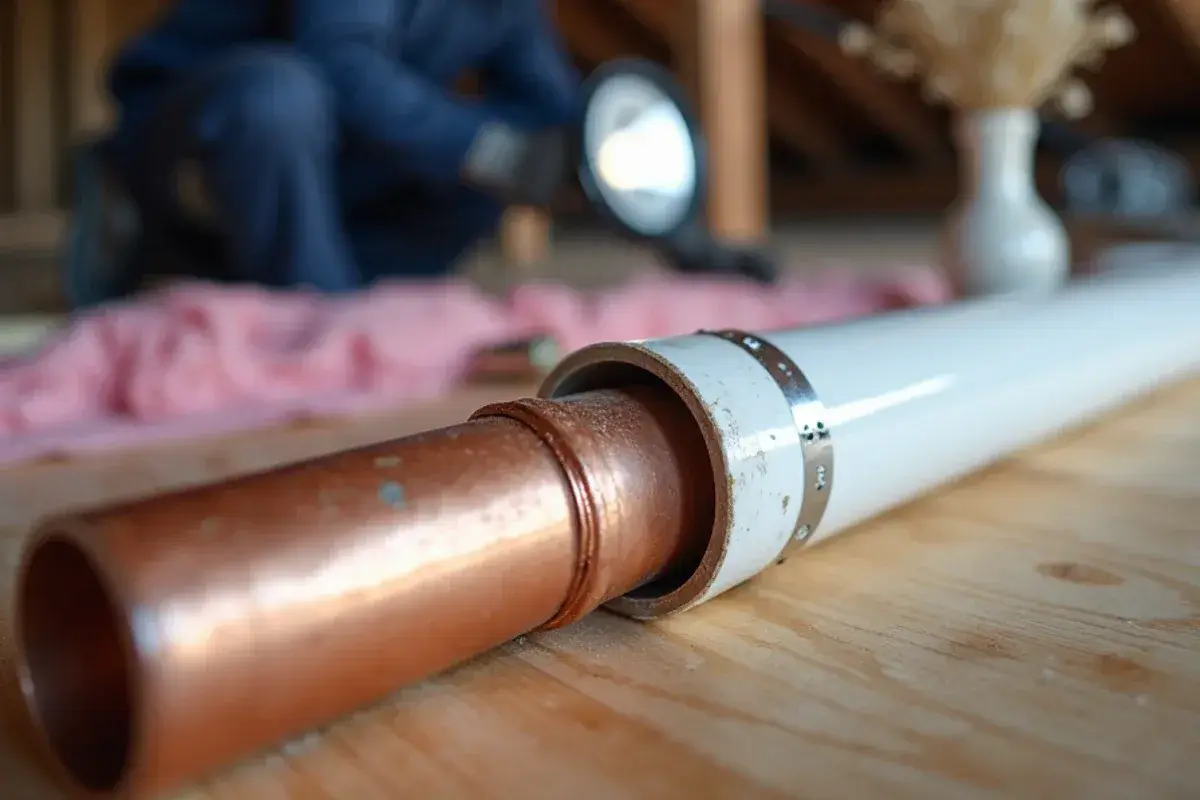
Materials fail differently. Copper usually splits lengthwise in a thin seam. PEX stretches and often survives, but its brass or plastic fittings can crack. Polybutylene and old galvanized lines tend to fail at joints, and a freeze simply finds the weakest one.
| Repair | When it fits | The trade-off |
|---|---|---|
| Repair clamp or push-to-connect fitting | A stopgap to get water back on | Quick, but meant to be replaced with a permanent joint |
| Cut out and splice in new pipe | One clean split in otherwise sound pipe | Permanent for that spot; the rest of the run is unchanged |
| Re-run the exposed section | Several damaged joints in one attic or wall | More drywall or insulation work, fewer weak points left |
| Whole-house repipe | Polybutylene, galvanized or repeat failures | The biggest job, but it ends the cycle of patches |
A good burst pipe repair ends with the system under pressure and every fixture checked, because freezes rarely break only one spot. Ask the plumber to look at the hose bibs, the attic runs and the water heater connections before they leave.
Insurance
What should you photograph and keep for the insurance claim?
The Texas Department of Insurance gives clear, general guidance. Your own policy decides the rest.
According to the Texas Department of Insurance, most homeowner and renters policies cover sudden and accidental water damage, and a burst pipe is its own example. TDI also notes that policies usually do not cover damage from gradual leaks. Read your declarations page and endorsements, because wording differs between companies.
TDI’s advice is to stop the leak as soon as you can, remove standing water and start drying, since mold can begin growing within a day. Make temporary repairs only, and leave permanent work until the insurer has seen the damage.
Before the adjuster arrives
- Photos or video of the broken pipe, the water path and every wet room
- A list of damaged belongings, kept with the items until the adjuster has seen them
- The plumber’s written description of what failed and where
- Receipts for fans, tarps, buckets and any temporary repair parts
- The date and time you found the leak and when you closed the valve
Tell your insurance company as soon as possible. For what a Texas policy typically includes after a freeze, see our guide to homeowners insurance and burst pipes. This is general information, not legal advice.
Prevention
How can you stop the next hard freeze from splitting a line?
Central Texas freezes are short but sharp, and the houses here were not built for them.
Most local homes run supply lines through the attic and along exterior walls. That suits a hundred August days and fails on one night in the teens. A few cheap habits close most of the gap.
- Disconnect garden hoses and cover each hose bib with an insulated cap
- Wrap attic lines and any pipe in an exterior wall you can reach with foam sleeves
- Open sink cabinet doors on outside walls so room heat reaches the pipes
- Let a thin stream run from the faucet farthest from the meter on the coldest nights
- Label the main shut-off and show everyone in the house how to close it
- If you travel in winter, close the main and drain the lines before leaving
Homes that lost power during Uri froze from the inside, which no foam sleeve fully prevents. In that case, closing the main and draining the system is the only reliable protection. Our post on freeze-proofing pipes after Uri goes room by room.